Pages

I studied 10 years of Instagram posts. Here’s how social media has changed


Image: Pramod Tiwari / Unsplash


Instagram is one of Australia’s most popular social media platforms. Almost two in three Aussies have an account.

Ushering in 2026 and what he calls “synthetic everything” on our feeds, Head of Instagram Adam Mosseri has signalled the platform will likely adjust its algorithms to surface more original content instead of AI slop.


Finding ways to tackle widespread AI content is the latest in a long series of shifts Instagram has undergone over the past decade. Some are obvious and others are more subtle. But all affect user experience and behaviour, and, more broadly, how we see and understand the online social world.

To identify some of these patterns, I examined ten years’ worth of Instagram posts from a single account (@australianassociatedpress) for an upcoming study.

This involved looking at nearly 2,000 posts and more than 5,000 media assets. I selected the AAP account as an example of a noteworthy Australian account with public service value.

I found six key shifts over this timeframe. Although user practices vary, this analysis provides a glimpse into some larger ways the AAP account – and social media more broadly – has been changing in the past decade.

Reflecting on some of these changes also provides hints at how social media might change in the future, and what that means for society.

1. Media orientations have shifted

When it launched in 2010, Instagram quickly became known as the platform that re-popularised the square image format. Square photography has been around for more than 100 years but its popularity waned in the 1980s when newer cameras made the non-square rectangular format dominant.

Instagram forced users to post square images for the platform’s first five years. However, the balance between square and horizontal images has given way to vertical media over time.

On the AAP account that shift happened over the last two years, with 84.4% of all its posts now in vertical orientation.


The use of media in vertical orientation spiked on the AAP Instagram account in 2025. T.J. Thomson

2. Media types have changed

As with orientations, the media types being posted have also changed. This is due, in part, to platform affordances: what the platform allows or enables a user to do.

As an example, Instagram didn’t allow users to post videos until 2013, three years after the platform started. It added the option to post “stories” (short-lived image/video posts of up to 15 seconds) and live broadcasts in 2016. Reels (longer-lasting videos of up to 90 seconds) came later in 2020.

Some accounts are more video-heavy than others, to try to compete with other video-heavy platforms such as YouTube and TikTok. But we can see a larger trend in the shift from single-image posts to multi-asset posts. Instagram calls these “carousels”, a feature introduced in 2017.

The AAP went from publishing just single-image posts in the first years of the account to gradually using more carousels. In the most recent year, they accounted for 85.9% of all posts.


Following the introduction of carousel posts on Instagram in 2017, the AAP account’s use of them peaked in 2025 with 85.9% of all posts. T.J. Thomson

3. Media are becoming more multimodal

A typical Instagram account grid from the mid-2000s had a mix of carefully curated photographs that were clean, colourful and simple in composition.

Fast-forward a decade, and posts have become much more multimodal. Text is being overlaid on images and videos and the compositions are mixing media types more frequently.

There are subtitles on videos, labels on photos, quote cards, and “headline” posts that try to tell a mini story on the post itself without the user having to read the accompanying post description.

On the AAP account, the proportion of text on posts never rose above 10% between 2015 and 2024. Then, in 2025, it skyrocketed to being on 84.4% of its posts.

4. User practices change

Over time, user practices have also changed in response to cultural trends and changes of the platform design itself.

An example of this is social media accounts starting to insert hashtags in a post comment rather than directly in the post description. This is supposed to help the post’s algorithmic ranking.

Another key change over this timeframe was Instagram’s decision in 2019 to hide “likes” on posts. The thinking behind this decision was to try to reduce the pressure on account owners to make content that was driven by the number of “like” interactions a post received. It was also hypothesised to help with users’ mental health.

In 2021, Instagram left it up to users to decide whether to show or hide “likes” on their account’s posts.

5. The platform became more commercialised

Instagram introduced a Shop tab in 2020 – users could now buy things without leaving the app.

The number of ads, sponsored posts, and suggested accounts has increased over time. Looking through your own feed, you might find that one-third to one-half of the content you now encounter was paid for.

6. The user experience shifts with algorithms and AI

Instagram introduced its “ranked feed” back in 2016. This meant that rather than seeing content in reverse chronological order, users would see content that an algorithm thought users would be interested in. These algorithms consider aspects such as account owner behaviour (view time, “likes”, comments) and what other users find engaging.

An option to opt back in to a reverse chronological feed was then introduced in 2022.

To compete with apps such as Snapchat, Instagram introduced augmented reality effects on the platform in 2017.

It also introduced AI-powered search in 2023, and has experimented with AI-powered profiles and other features. One of these is turning the content of a direct message into an AI image.

Looking ahead

Overall, we see more convergence and homogenisation.

Social media platforms are looking more similar as they seek to replicate the features of competitors. Media formats are looking more similar as the design of smartphones and software favour vertical media. Compositions are looking more multimodal as type, audio, still imagery, and video are increasingly mixed.

And, with the corresponding rise of AI-generated content, users’ hunger for authenticity might grow even more.The Conversation

T.J. Thomson, Associate Professor of Visual Communication & Digital Media, RMIT University

At the official invitation of the Republic of Indonesia, this evening, H.E. Sheikh Dr. Mohammed Al-Issa, arrived at Halim Perdanakusuma International Airport in Jakarta, the capital of Indonesia


At the official invitation of the Republic of Indonesia, and as part of a series of meetings and events:

This evening:

H.E. Sheikh Dr. Mohammed Al-Issa , Secretary-General of the Muslim World League (MWL) and Chairman of the Organization of Muslim Scholars, arrived at Halim Perdanakusuma International Airport in Jakarta, the capital of Indonesia. He was received by H.E. Mr. Ahmad Muzani, Speaker of People's Consultative Assembly of the Republic of Indonesia, along with a number of religious leaders and senior officials.


Apple's Executives Elaborated on How Crash Detection Works

 Recently, two senior executives at Apple highlighted the working of the latest technological advancement, crash detection.


The latest crash detection feature is built-in in the latest models of iPhone 14 and apple watches. Its task is to detect emergency vehicle crashes and inform the emergency services in case of no replies from the user. On being tested by various reviewers, the feature has performed brilliantly. As per the official Apple sources and multiple tests carried out, the feature activates itself at a crash. Within no replies in 20 seconds, an automatic alert with the exact location will be sent to the emergency services.

Despite the merits, the following feature has a problem. Whether you are using an iPhone 14 or the latest Apple watch, the feature automatically enables itself if you are on a roller coaster ride. However, the developers are working to fix this issue. The crash detection system's working is not as simple as it looks. The team highlighted that the higher gravitational forces are a massive clue for car detection, and that is also the biggest reason why the feature automatically activates itself in roller coaster rides.

The top executives also highlighted the fact that there is no single dependent unit of this feature. However, it depends on multiple signals such as acceleration, GPS, gyroscope, accelerometer, etc. Besides this, Bluetooth and Wi-Fi connectivity also play a vital role in this feature. They are used to determine whether you are present in a car or not. Also, a mix of road noises and engine noises is an important asset of this feature.

Furthermore, the feature also includes the automatic use of satellite SOS. This feature is useful for remote areas where there is a lack of signals. Also, Apple is the first organization to embark satellite option in its iPhone 14.

According to the team, in case of no contact, they will automatically dial an emergency number with your device. In case of no contact, the feature is capable of switching the network and contacting emergency assistance. In case of zero coverage, it will try to connect the emergency SOS via the satellite.

To conclude, the following update can also be a question mark for Apple as no other competitors have been using the following features but the tech giant loves to take the risk to conquer the peaks of advancement in the fields of technology.

New Alarming Report Says TikTok Earns Huge Profits From Livestreams Featuring Kids Begging

 A new alarming report by the BBC has spoken in detail about how the popular video app TikTok is earning huge profits thanks to live-streams showing needy children begging for donations.


In particular, the focus was the refugee crisis in Syria where so many families were left with no decision but to be displaced and hence are begging for financial assistance. Shockingly reports went into detail about how the firm takes nearly 70% of all proceeds gathered as confirmed by a recent investigation.


It’s shocking to see how some streams went as far as earning a staggering $1000 each hour as kids begged to receive some gifts that had cash value. But what’s interesting is how the report noted that the people begging for money actually got very little of the proceeds.

Now that the matter has been highlighted in the eyes of the public, the platform says it's working hard to prevent such situations where exploitative begging is turning into a norm. Moreover, it denied all accusations put up against it that it was making money through such means and vowed that it had policies in place to eradicate such content on the app.

But it did not wish to comment on the amount of commission it gained through such proceeds and that just goes to show that the reports are true. During the early part of this year, we saw the platform fill users’ feeds with stories of the dire situation in Syria and how so many families were in need of great assistance.

That did draw a lot of support across the board as some of the images and videos were so distressing and heartbreaking that you couldn’t just overlook them. Hence, the report shed light on how this was a whole campaign led by certain middlemen that had the necessary means to go live and promote the cause.

These individuals claim to be working by the side of different agencies found in China that were linked to the app. They’re a part of TikTok and they’re giving such families access to the app as a global strategy to get live streams up and running so more and more people spend precious time on the application.

It’s interesting that most middlemen had sim cards belonging to the UK and they’re on a mission to try and get more and more people to participate in the drive by appealing to the masses.

Remember, it’s already known that those users living in the UK tend to be more grateful and generous at heart than all others. And it’s amazing the types of digital gifts that people are willing to give like virtual lions and digital flowers. It’s like tipping creators for the content that they produce.

Next up, it was interesting to see how the BBC report began tracking down where exactly all the funds sent out went if the actual people at the other end only claim to get a fraction of it. And that’s when it was revealed that most of the funds went to the platform.

Those at the donating end were furious to learn about that because they felt it was like cheating and tricking them into making donations while the deserving got very little in return.

The fact that it’s a whole network of scams where families are making a living through the sad lives of others is just outrageous and the report is really raising the curtain on the endeavor.

Now, leading content creators are also jumping on board and have their say on the alarming matter. They’re raising awareness and calling the action a move that lacks dignity and tries to gain sympathy by exploiting or taking advantage of minors.

Instagram Is Keen On Maximizing Revenue As It Experiments With Innovative Ad Options

 The holiday season is upon us all and Instagram is making sure it doesn’t lose out on any chance coming soon.


The platform has recently spoken about a series of innovative ad options that are designed keeping in mind maximal revenue generation. This is also said to give more brands an array of opportunities. However, we don’t feel it can be a very popular addition in terms of users. After all, who loves ads in the first place?

For starters, the app says it is adding some new features to its Explore Tab. This page now has its own unit for ads that may be seen across content feeds. The example of the ad put forward by the company is quite big and we’ve got zero confirmation if all the advertisements will be just as mighty as this.

Whatever the case may be, it’s a huge opportunity to reach out to the audience on the app during the early stage of their discovery, especially in terms of content that they love.

We do see this as a great consideration to have some businesses’ products getting featured across the main feed on the app. In the same way, we’re seeing Instagram test out more ads in its profile.

This is the type of feed experience that users can get accustomed to after they visit a certain profile or tap on a particular post. Hence, the next time you like a post on a follower’s account, be prepared to receive ads within your area of interest.
The platform is also searching for ways to make this option a form of monetization for all of the app’s creators. Remember, all of the activities are linked to a particular profile so that makes sense.

Instagram says it’s also experimenting with a new feature called ‘multi-advertiser ads’. This displays a lot more promotions via similar entities, right after engagements with an ad are complete.

Whenever a person is seen expressing a form of commercial intent through direct engagement with ads, similar ads are delivered in greater quantities from other firms. The subject is of interest, thanks to the AI- tools of machine learning.

All in all, the app is looking forward to adding more forms of related business. And if that means adding more ads on users, then so be it. For now, we aren’t quite sure how effective this might turn out to be. But it might end up getting your brand in the driver’s seat of users showing interest in the niche, depending on if they’ve engaged in it in the past.

Last but not least, Instagram is getting started for a test of AR ads. These can be found on Instagram’s Feed and the app’s Stories section.

Designed in the app’s Spark AR platform, these types of AR ads will invite people to engage with ads more. This can include the likes of placing virtual paintings in your drawing room or even test driving some vehicle.

Meta says by giving a brand the right tools to develop a more immersive experience, they’re really keen on driving performances and helping them prepare for the ongoing metaverse taking place.

Although the worlds of AR and VR are worlds apart, creating three-dimensional objects is a key feature for the next stage. This will ultimately assist in advancing to the next stage with ad measures.

We won’t lie, the considerations here are quite interesting. But we also feel we might be seeing more marketing take place on your feed through the app. And that’s not the best news for viewers.


How Are People Viewing Tech Changes In Today’s Time? Meta Shares Its Valuable Insights

 Have you ever wondered what the common man feels about the metaverse or any technology change in general? Well, for many, it’s a vague phenomenon, and not too many people are clear with the concept too.


Just recently, we saw Apple’s Tim Cook shed light on how most people aren’t even aware of the term, let alone the meaning. And that could be concerning.

But now, Meta is moving in to shed some light on what people actually think of tech shifts like the metaverse. Is it really the next biggest and best thing in the digital world? Considering the fact that it’s still non-existent, we were quite curious about the ordeal.

Meta conducted a survey as they wished to see what people felt about the tech world and its many shifts. This survey had nearly 30,000 shoppers that arose from different parts of the world. They wished to see what these people really felt about the concept of technology reaching the skies.

On that note, Meta says that they found so many people are actually keen on new or modern-day experiences. They are curious about how much technology has evolved with time and their avatars were super stylish. They also wanted to feel more connected with the different businesses that are providing them services.

Interestingly, around 28% of the population have utilized AR while carrying on with their shopping. On the other hand, around 42% state AR may enhance their entire shopping experience by joining the gap seen across in-person stores and those found online.

We find that to be super true, especially when it comes to AR tools that enhance the entire shopping experience seen online. But again, AR and VR are two very different entities.

This is the type of technology that the company uses to market projects like the metaverse. But the latter isn’t all. There are several other projects that come in that category too. Very few people think of the metaverse as something special. For them, it’s like a synonym for technical advancement.

The metaverse is nowhere near being completed. It needs a lot more support in the form of partners and also the agreements to charge ahead for cross-platform linking between various tech apps. As of now, very few people have any interest in this. It’s more like Meta having high hopes of the metaverse but no one else. They’re clearly on a separate page from all of us.

On the other hand, there were quite a few other findings seen in this survey. Around 41% of those surveyed felt the metaverse would truly be a huge deal that alters shopping experiences.

Moreover, around 50% felt virtual stores will put convenient shopping at the forefront. While a similar amount of people stated that success seen through gaming platforms could really make a huge difference and grab a user’s attention.

Did you ever wonder how Meta might be speaking too highly on a project that might be just words and little action? Seeing is believing and we’re all still waiting for some major improvements to come forward.

Users are happy with avatars as popular apps like Snapchat and Facebook have put them center stage. Today, they’re used with great enthusiasm for various online activities and during regular chats too.

It’s all thanks to gaming apps such as Roblox and Fortnite. Their popularity is immense and people enjoy playing in their avatar characters.

So there are plenty of exciting things being spoken about and advisors claim if you’d like to invest, now is the time to do it. You might regret it later. But again, how many are really willing to take the risk is a question worth pondering.


Illustration via: FreePik

Facebook Launches New Feature That Stops Irrelevant Content From Showing Up On Feeds

 Meta is launching new functionality that prevents users from seeing irrelevant content on their Facebook news feeds.


Meta says the new feature is designed to assist users in avoiding content that they find annoying or unappealing when they're scrolling. While the company did say that this new feature enables you to customize your entire news feed, it’s not enabling users to make the right changes. But you can help train the app’s algorithms to show content that you’re not interested in or find irrelevant.

A recent blog post regarding the matter revealed how the app will begin seeing a new tab that states, ‘show more’ or ‘show less’. These will be located right under your posts on the feed.

After the button for ‘show more’ gets selected, all such posts’ ranking scores will increase for that post or those similar to it. But when the option to show less is selected, the ranking score witnesses a decline. In this way, the algorithms of Facebook will make use of the feedback to enhance such posts across the feed.

It’s important to note how such buttons will not appear across all of the posts witnessed across a feed. But Meta does claim they could appear with time and routinely. Moreover, you may just see it pop up on a three-dot menu that’s located on the top right-hand side of a post.

Similarly, the app says they’re busy running a similar test feature across the Instagram app in Reels.

It’s worth a mention how YouTube is even offering some similar changes that will assist users in getting the content they wish to see on the platform. This way, video recommendations will get a boost. With that said, YouTube has been criticized, time after time. Their tools are called out as inefficient at keeping bad recommendations away. But who knows, this might be the change they needed.

At the same time, we’ve got some more news on how Meta is even thinking about a new option that allows users to design several profiles through the Facebook and Instagram applications, making use of the same user account.

The whole idea here is to get users to tell the difference between the various profiles, depending on the types of groups that they’re willing to connect with across so many platforms.


52% of Americans Report Seeing More Ads on Facebook

 Digital ads are the main source of income for most tech platforms, and users have been reporting seeing an increase in the number of ads that they are exposed to. 52% of Facebook users stated that they are seeing more ads than they used to, and that number is around 47% for YouTube. In spite of the fact that this is the case, most other platforms have a majority of users stating that the number of ads they are seeing has stayed more or less the same.


Facebook and YouTube are unique in that they are the only platforms that have more users reported a higher number of ads than those that say they are the same number. 39% of Facebook users and 45% of YouTube users said that the number of ads has stayed consistent, although there is clearly a far larger disparity when it comes to Facebook with all things having been considered and taken into account.

With all of that having been said and now out of the way, it is important to note that LinkedIn is satisfying its users the most in this regard, Only 20% reported an increase in the number of ads, with 64% saying that they are seeing the same number as before. Reddit, Pinterest, Twitter and Snapchat are also doing fairly well here with 54%, 55%, 53% and 48% of users respectively reporting the same ad volume. The percentage of users reporting higher ad volume for these platforms are 27% for Reddit, 29% for Pinterest, 35% for Snapchat and 37% for Twitter.

Things are a bit more dire in the world of TikTok and Instagram. TikTok performs marginally better, with 46% of users reporting the same ad volume compared to 41% reporting an increase. Instagram users are split right down the middle, with 44% saying they are noticing more ads and a further 44% reporting the same numbers as before.

Facebook’s recommendation algorithm is notorious for its low accuracy and success rate. That means that users are seeing more ads but there is only a 71% chance that the ad would be relevant.


TikTok’s Winning Streak Continues As Sales Grow Nearly Sixfold To Around $1 Billion

 TikTok’s sales have grown by more than six times its value to reach $1 billion as business operations in the United Kingdom flourish. This is all thanks to advertisers rushing on over to the popular Chinese social media firm.


The headquarters of the company in London, which also entails European operations and some divisions from China, reported around $990 million of gains in revenues over the past year. This is a massive $172 million rise compared to 2021.

These figures are a clear indication of the speed related to the Chinese firm’s massive rise in profits and growth. Moreover, its international division managed to reach a staggering $1 billion target in two years, thanks to the addition of advertising on the app. And that’s around six years since it last launched here.

When we compare this progress to that of Facebook, the app was seen hitting revenues of nearly $1 billion in Europe. And that’s around seven years of kickstarting operations here.

The losses incurred by Tiktok during this period were stated to have risen by a third, where a target of $896 million was recorded. They were spending a lot of funds on staff. We’re talking about an increase in workers by nearly 4300.

But these results are a clear indication of how great the app is performing and its winning streak has continued since the pandemic. Despite major lockdowns in place, people enjoyed the app even more as they were kept busy with such distractions.


Chart: The Telegraph
The findings in the report claim around $802 million were received through the likes of advertising as TikTok started including digital ads for its platform in 2020.

As you know, this app is very popular with Gen Z which includes teenagers and those in their early 20s. Most brands love reaching out to such target audiences.

The revenues for the app in the UK went up from $51 million to $280 million in 2021. And most of its business had put out sales of around $531 million.

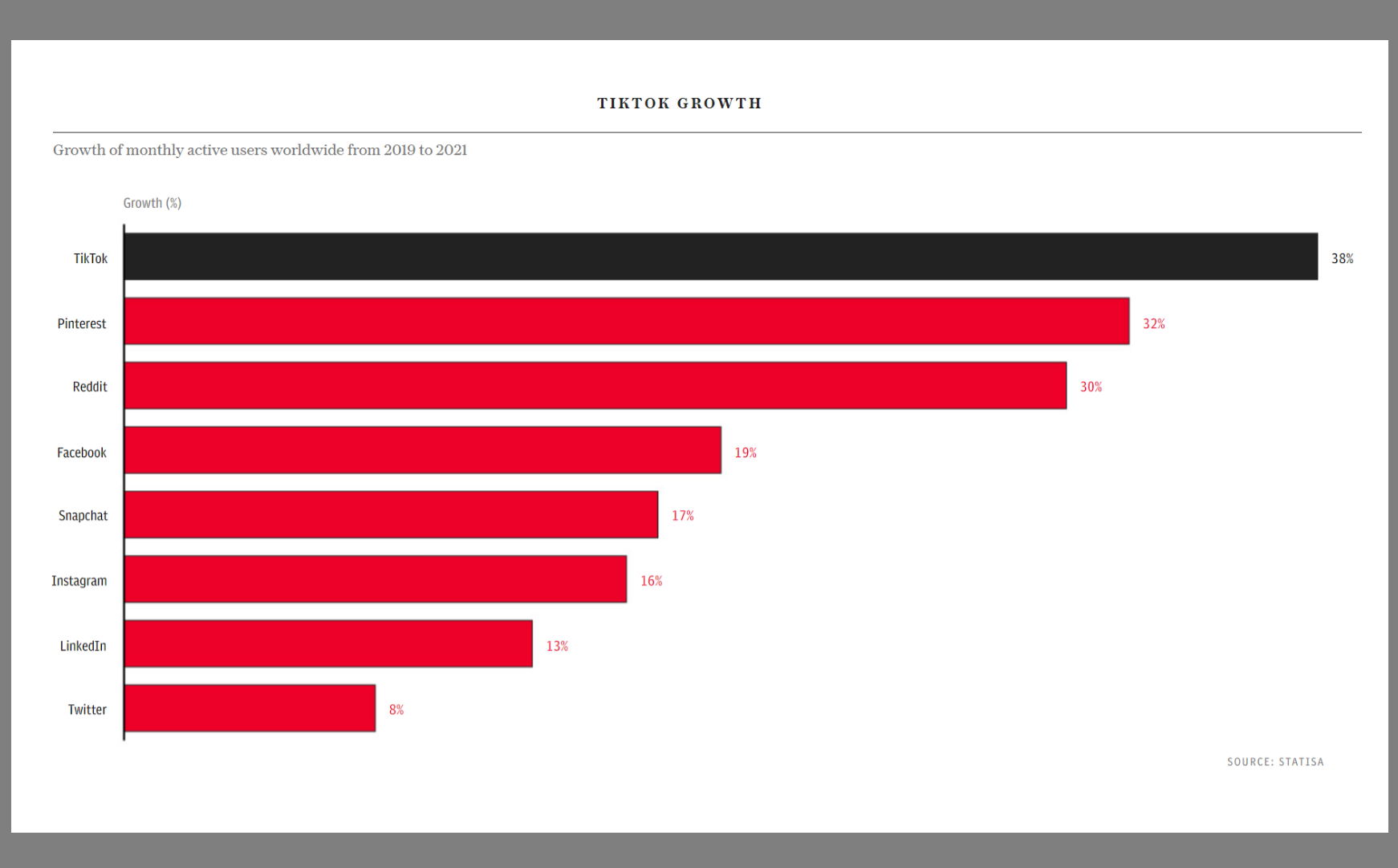
Around the globe, TikTok has nearly one billion users that use the app on a monthly basis. And it continues to provide the toughest competition to archrivals like Meta’s Facebook and Instagram that love to follow in its footsteps.

But the growth has also come at a time when the app is facing immense scrutiny. Be it regular or directly from lawmakers, there are plenty of security concerns involved here. A lot of it has to do with how data is used and the app’s ownership too.

As far as the UK is concerned, it’s facing a mega 27 million pounds fine for breaches of data protection. In the same way, the firm has been slapped with provisional warnings by the country commissioner's office. They reportedly spoke of shocking findings regarding TikTok and how it managed to process data pertaining to young children that were reportedly below 13 and had no consent from their parents as well. But the app blatantly denies all of those findings by the regulator.

In the same way, the firm was seen drawing up a massive agreement so it could be allowed to operate under the leadership of the ex-American president Donald Trump. He tried to push for the sale of the app’s business in the US as he held major reservations about it being owned by the Chinese.

Now, in the UK, a recent account on the app was even shut down as MPs held major concerns regarding data security.

Despite the massive growth, ByteDance which is the platform’s parent firm has been delaying a massive $300 billion float as its valuation dropped in the private market. We even saw the firm’s founder quit in the previous year due to pressure from the capital.

H/T: Financial Times.

TikTok’s Latest Review Depicts Mega 62% Rise In Fake Accounts On The App

 While many may have spoken about how positive of a year TikTok has had and how its dominant market share has resulted in so many top platforms losing screen time against the archrival, well, there is some bad news too.


The company was seen publishing its latest review of Q2 this year in terms of responses linked to Community Guidelines. And that entails all forms of videos and profiles that were either deleted or taken action against.

And as the famous saying goes, the more users, the greater the problems. And that seems to have taken place right now.

TikTok is being extra stringent in terms of action taken by its board against those violating the community guidelines. This could include those breaking rules or those coming up with fake accounts. Either way, they’re removed from the platform but to see a mega 62% rise in the number is appalling, to say the least.

For starters, let’s begin with the amount of video content that made its way off of the platform. Think along the lines of 113 million that took place between the months of April to June. This was an 11% rise from the previous quarter. But the trend does make some sense as it came with steady growth in viewers as well.

As can be witnessed in a recent chat of the overview put up by the app, there is plenty of misuse, and how this particular challenge manages to increase with time on the app.

What we love is how the app manages to get rid of content that breaks violations, right before anyone gets a peek so this fast action behavior is always recommended.

TikTok is really doing plenty to have its users be safeguarded against harmful exposures but critics aren’t too happy with the way it’s handling misinformation.

A new study put up by NewsGuard says 1 in 5 search results on the app is definitely misleading, including one topic linked to an mRNA vaccine.

This is super interesting because it doesn’t seem to be getting better with time and it’s causing a concern as seen with other platforms.

According to a recent study conducted by NewsGuard, up to 1 in 5 search results in the app contains misinformation, including searches for ‘2022 election’ to ‘mRNA vaccine’. Which is an interesting counter to TikTok’s own data, which would suggest, in isolation, that TikTok’s getting much, much better on this front.

There was also plenty of talk about how one of the app’s most important concerns is linked to the safety of minors. The fact that the platform has so many users means there are allegations that it might be putting up more content belonging to young females so as to try and lure people to continue scrolling on the feed.

As we get deeper into the matter, it was revealed by TikTok how explicit content and nudity were one of the major reasons for content removal on the app. And this continues to be an area of growing concern for so many people. TikTok says it’s trying hard to get rid of such content but experts feel its algorithms do promote such content too.

But the biggest for eliminating accounts has to do with fake profiles and seeing the 62% rise is just mind-blowing as stats are compared with the previous quarter.

The mere fact that we’re seeing such fake profiles come into existence makes one realize the great value that today’s content creator industry holds and how the market filled with fake users is on the rise.

TikTok also revealed how it’s testing a new program for fact-checking so false content is flagged immediately on the web.


TikTok is the Least Trusted News Source According to This Survey

 Social media can be useful place to gather news, but in spite of the fact that this is the case most people don’t seem to trust tech platforms for news. These platforms have become notorious due to the high quantity of misinformation and fake news that is present on them, although Google seems to be more trustworthy than most other platforms that are out there. A survey recently conducted by Reuters shed some light on which platforms are trusted and which aren’t with all things having been considered and taken into account.


With all of that having been said and now out of the way, it is important to note that trust in news in general is on the decline. Around 46% of British respondents to this survey stated that they don’t like to read the news anymore. 52% said that they trusted Google as a source of news, but only 20% said the same for TikTok.

Meta’s platforms including Facebook and Instagram also performed really poorly based on this survey. Only 27% of the people that responded to this survey said that they trusted news that they got from Facebook, and only 24% said the same for Instagram.

In the US, only 49% of people trust the overall news cycle, but they tended to trust news more than might have been the case otherwise if they got it from Google. 53% of American respondents to this survey said that they trusted news from Google, which suggests that Google is a far more trustworthy outlet than the wider news industry.

There is also quite a bit of disparity based on the ages of the people who were interviewed and surveyed. For example, only 3% of people aged over 55 trusted news from TikTok, but for people under the age of 35 this number jumped to around 40%. Hence, younger people are more trusting of social media platforms likely due to their ability to navigate the landscape of fake news and their higher degree of knowledge that helps them spot misinformation and avoid giving it any credence while they consume news.